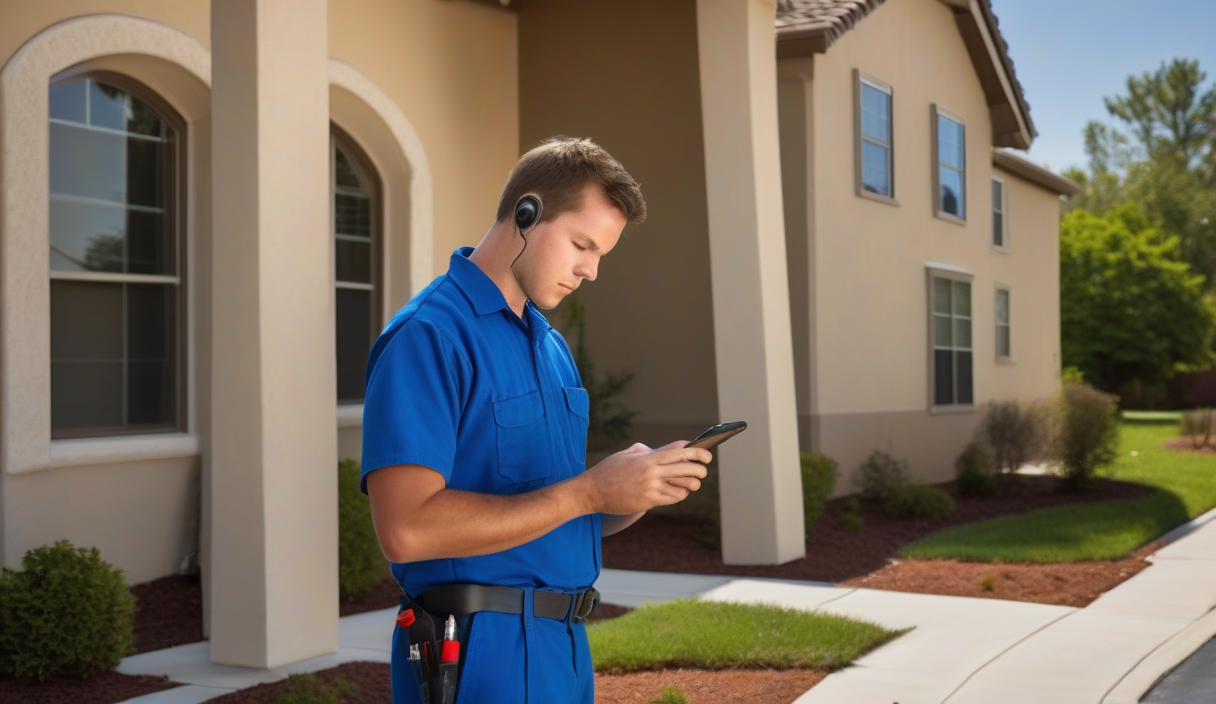
What does an HVAC contractor website actually need to book jobs in Sanford?
If your HVAC site doesn’t produce calls, the problem is almost never the color scheme — it’s missing trust signals, slow load times, or zero local SEO. In Seminole County’s competitive market, where homeowners search “AC repair Sanford FL” at 9 p.m. when their system fails, your site has roughly four seconds to prove you’re the right call before they tap back and choose someone else.
Here’s what actually moves the needle, drawn from what works for service contractors in this specific market.
Your phone number needs to be unavoidable on mobile
Over 70% of home-service searches happen on a phone, according to Google’s research on local search behavior. An HVAC emergency isn’t a comparison-shopping situation — the homeowner wants to call right now.
Practically, this means:
- A sticky header with a click-to-call button that scrolls with the user
- Your phone number in the hero section, above the fold, in a font size no smaller than 24px
- A “Request a Free Estimate” form that’s three fields max: name, phone, what’s wrong
If your current site buries the number in the footer or makes mobile visitors pinch-and-zoom, you’re losing jobs every day.
Page speed is a ranking factor — and most HVAC sites fail it
Google’s Core Web Vitals score affects where you appear in local search results. A bloated, image-heavy site built on a slow shared server will load in 6–8 seconds. On a July afternoon in Sanford when the temperature is 94°F and someone’s AC just died, they won’t wait.
Target a Largest Contentful Paint (LCP) under 2.5 seconds. You can test yours free at web.dev/measure. Common fixes for contractor sites: compress hero images, switch to a faster host, and eliminate unnecessary plugins.
Our managed hosting is configured specifically for this — sites we host consistently score in the “Good” range on Core Web Vitals without the client needing to think about it.
Local SEO signals: the difference between ranking in Sanford vs. nowhere
Ranking for “HVAC contractor Sanford FL” requires more than dropping the city name in your homepage headline. You need:
Dedicated service area pages. One page per city — Sanford, Lake Mary, Heathrow, Longwood, Oviedo — each with unique content (200+ words), a Google Map embed, and mentions of local neighborhoods or landmarks. “We service the Celery City area and surrounding Seminole County communities” does more than a generic blurb.
Google Business Profile, fully built out. Photos, services listed, Q&A populated, and a steady stream of reviews. Reviews on your GBP and displayed on your website create a reinforcing trust loop. Google Business Profile is free and most Orlando-area contractors set it up halfway — fully completing it is a competitive advantage.
Schema markup. Structured data that tells Google you’re a local HVAC contractor, your service area, and your hours. This is backend code, not visible on the page, but it improves how your listing appears in search results.
For a deeper look at pairing your site with local search strategy, our local SEO & AEO services cover the ongoing optimization work that compounds over time.
Trust signals that convert cold visitors into booked jobs
Someone who finds your site through Google doesn’t know you. They need fast proof you’re legitimate. On a contractor site, that means:
- Contractor license number displayed prominently (Florida requires HVAC contractors to be licensed — show it)
- Named Google reviews pulled onto the site with the reviewer’s name and star rating
- Before/after photos from actual Sanford-area jobs, not stock imagery
- Clear service list with brand logos for equipment you service (Carrier, Lennox, Trane, etc.)
- Years in business and service area stated plainly in the header or hero
A homeowner in a Lake Mary subdivision or a Sanford historic-district bungalow needs different trust than a commercial property manager — make sure your copy speaks to the residential or commercial split you actually serve.
Automations that capture leads when you’re on a job
HVAC contractors work in attics and crawl spaces all day. You can’t answer every call. A well-built site captures those leads automatically:
- Estimate request form with email and SMS notification to you instantly
- Automated confirmation text to the homeowner within 60 seconds of form submission
- Maintenance reminder sequence for existing customers via email (“Your spring tune-up is due”)
These aren’t complex to set up — three core automations can replace a part-time admin role for a solo or small HVAC operation.
For HVAC contractors ready to stop losing jobs to competitors with better sites, our construction & contractor web design service is built for exactly this use case — not a repurposed restaurant template, a site built around how service contractors actually get found and hired in Central Florida.
Frequently asked questions
How much does a professional HVAC contractor website cost in Sanford, FL?
A purpose-built HVAC site from a local designer typically runs $2,500–$6,000 depending on the number of pages, service area coverage, and whether booking or estimate forms are included. Template-based DIY options cost less upfront but often lose you more in missed leads.
How long does it take to build an HVAC contractor website?
A well-scoped HVAC site usually launches in 3–5 weeks when the contractor provides photos, service details, and feedback promptly. Rushing it to two weeks often means skipping the local SEO groundwork that makes the site actually earn calls.
Do I need separate pages for every city I serve?
Yes — if you want to rank in Heathrow, Lake Mary, or Longwood in addition to Sanford, each location needs its own page with unique content, local landmarks, and a Google Map embed. One generic 'Service Area' paragraph won't rank for any of them.
What's the most important thing an HVAC website needs to convert visitors?
A prominent, mobile-optimized phone number and a short estimate request form above the fold. Most HVAC leads decide within seconds — if your number isn't visible immediately on a phone screen, they back out and call the next result.
Should my HVAC site have a blog?
Only if you'll update it. A blog with two posts from 2021 signals neglect. If you can commit to even four posts a year covering topics like 'when to replace your AC in Central Florida' or 'why your Sanford home's humidity won't drop,' it compounds organic traffic meaningfully over 12–18 months.

Derl McMeekin
Founder of ProDesigning Creative. 24+ years designing, building, and growing websites — founded in Salt Lake City in 2002, based in Orlando since 2019.